
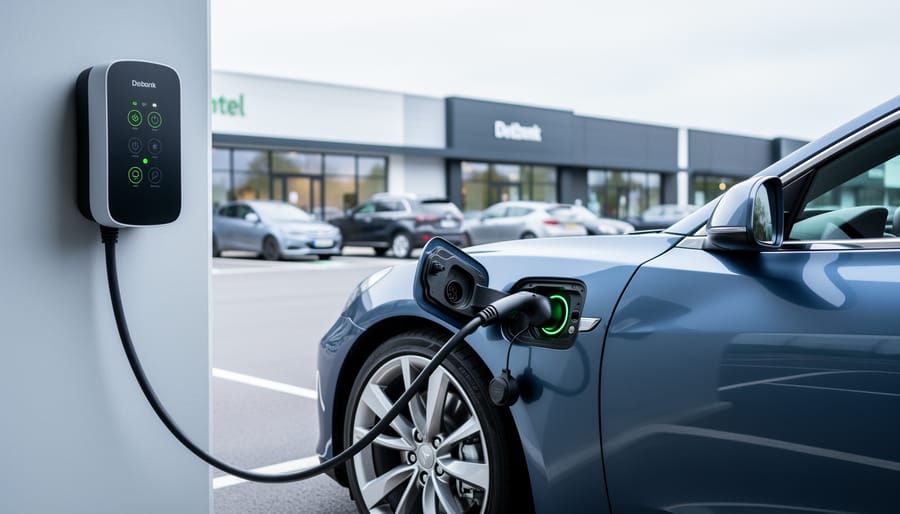
What Is 3 Phase Charging (and How Does It Work)?
Three-phase charging refers to an electric vehicle charging method that uses three alternating current (AC) power lines instead of one, allowing compatible EVs to charge up to three times faster than single-phase charging at the same amperage.
If you’ve ever plugged your EV into a home charger and wondered why some drivers can add range so much quicker, the answer often comes down to the electrical infrastructure feeding their charge point. While most residential properties in North America run on single-phase power, many commercial buildings and some newer homes have access to three-phase electrical systems, a difference that dramatically affects how quickly you can replenish your battery.
The distinction matters more than you might think. Sarah, a WeGoElectric community member from Portland, cut her charging time from eight hours to under three when she upgraded to a three-phase charger at her small business location. For fleet operators, delivery services, and anyone who needs their EV road-ready quickly, understanding whether your vehicle and location can take advantage of three-phase power is essential.
This guide breaks down exactly how three-phase charging works, which vehicles support it, where you’ll find it installed, and whether pursuing a three-phase setup makes sense for your driving needs and electrical service. Whether you’re evaluating home charging options or trying to understand the specs at public charging stations, knowing the difference between single and three-phase systems helps you make smarter decisions about your EV infrastructure.
What 3 Phase Charging Means for EV Drivers
Three phase charging delivers electrical power through three separate alternating currents instead of one, allowing your EV to charge significantly faster than with standard single phase charging. Think of it like filling a swimming pool: single phase is like using one garden hose, while three phase is like using three hoses simultaneously, the pool fills roughly three times faster because you’re moving more water at once.
The key difference lies in how electricity flows from the grid to your vehicle’s battery. Single phase power sends electricity along one live wire (plus a neutral), delivering a single wave of alternating current. Three phase power uses three live wires, each carrying its own alternating current wave that’s slightly offset from the others, creating a constant, smooth flow of power rather than the peaks and valleys of single phase.
- 3 Phase Power
- An electrical system using three separate conductors carrying alternating currents offset by one-third of a cycle, enabling higher power delivery without requiring thicker cables.
- Single Phase Power
- The standard household electrical system using one live conductor and a neutral, commonly limited to 7.4 kW for EV charging in most homes.
- AC Charging
- Alternating current charging that flows through your car’s onboard charger to convert AC power from the grid into DC power for the battery, unlike DC fast charging which bypasses this step.
- Kilowatts (kW)
- The measure of charging power indicating how much energy flows per hour, where higher kW explained ratings translate directly to faster charging times.
A common misconception is that three phase charging is the same as DC fast charging. It’s not. Three phase is still AC charging, just with more power capacity, typically 11 kW or 22 kW compared to single phase’s 3.7 kW or 7.4 kW. Another myth: you can’t use three phase chargers with a single phase vehicle. You can, but your car will only draw what its onboard charger can handle, wasting the extra capacity.
How 3 Phase Charging Works

When you plug your EV into a 3 phase charging station, you’re tapping into three separate electrical currents working together like three lanes of traffic moving simultaneously instead of one. Each phase delivers power to your vehicle at slightly different times in a coordinated pattern, allowing more electricity to flow into your battery without overloading the system. Think of it as three garden hoses filling a pool instead of one, the water (electricity) arrives faster because multiple streams work in parallel.
Here’s what happens during the charging process: electricity flows from the grid through three distinct wires, each carrying an alternating current that peaks at different moments. Your EV’s onboard charger receives all three phases and converts this alternating current into direct current that your battery can store. Because the three currents are offset by 120 degrees from each other, there’s always power flowing at any given moment, creating a smoother, more consistent energy transfer than the peaks and valleys of single phase charging.
The onboard charger acts as the translator between the grid and your battery, determining how much of that available power your vehicle can actually accept. A car with an 11 kW onboard charger connected to a 22 kW three phase station will still only charge at 11 kW, the charger sets the maximum intake rate. However, the three phase supply ensures that full 11 kW flows consistently without the gaps inherent in single phase delivery.
This method proves more efficient because the balanced load across three phases reduces energy loss as heat and minimizes strain on the electrical infrastructure. The grid experiences less voltage fluctuation, and your vehicle receives a steadier charging current, which can extend battery life over time compared to the uneven power delivery of single phase systems.
Types of 3 Phase Charging Configurations
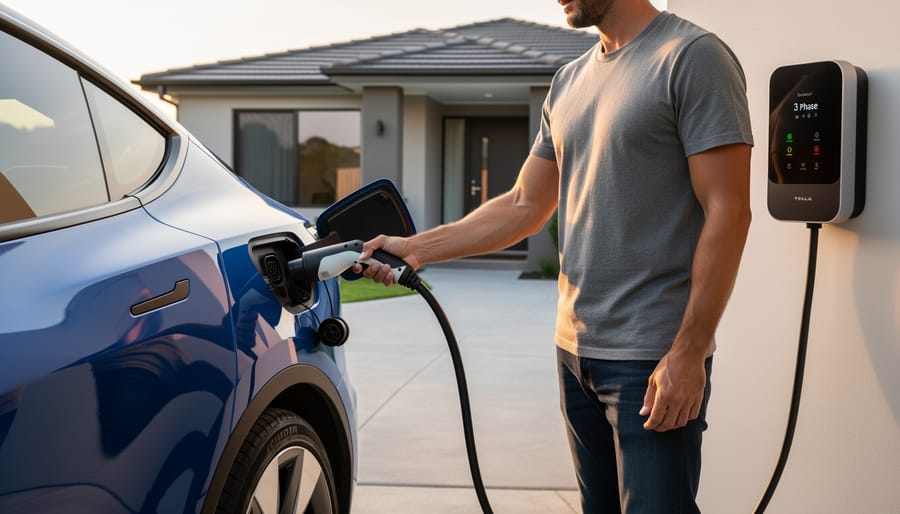
Three phase charging setups come in several configurations, each designed to meet different needs and deliver varying power levels. Understanding these options helps you pick the right solution for your charging situation.
Home Installations: 11 kW and 22 kW
For residential use, 3 phase home chargers typically offer either 11 kW or 22 kW output. An 11 kW unit delivers roughly 40-50 miles of range per hour of charging, making it suitable for most daily driving needs. If you regularly cover longer distances or want to top up faster between trips, a 22 kW installation can add 80-100 miles of range in the same hour. The catch? Your home needs a 3 phase electrical supply, something more common in newer builds and rural properties than older urban homes. Before you choose a charger check with an electrician whether your property already has 3 phase power or if you’d need an upgrade from your utility provider.
Public Charging Stations
Many public charging networks use 3 phase configurations to serve multiple vehicles simultaneously. These stations often provide 7 kW to 22 kW charging points, balancing power distribution across several bays. You’ll find them at shopping centres, park-and-ride facilities, and along major routes. The advantage here is consistent, reliable charging while you run errands or attend appointments.
Workplace Chargers
Employers installing charging infrastructure frequently opt for 3 phase setups to support their fleet or employee vehicles. A typical workplace installation might feature multiple 11 kW points fed from a single 3 phase supply, allowing several cars to charge throughout the workday. This approach maximizes the building’s existing electrical capacity without requiring separate high-power connections for each charging bay, making it cost-effective for businesses supporting sustainable commuting.
Real-World Applications: Where You’ll Find 3 Phase Charging
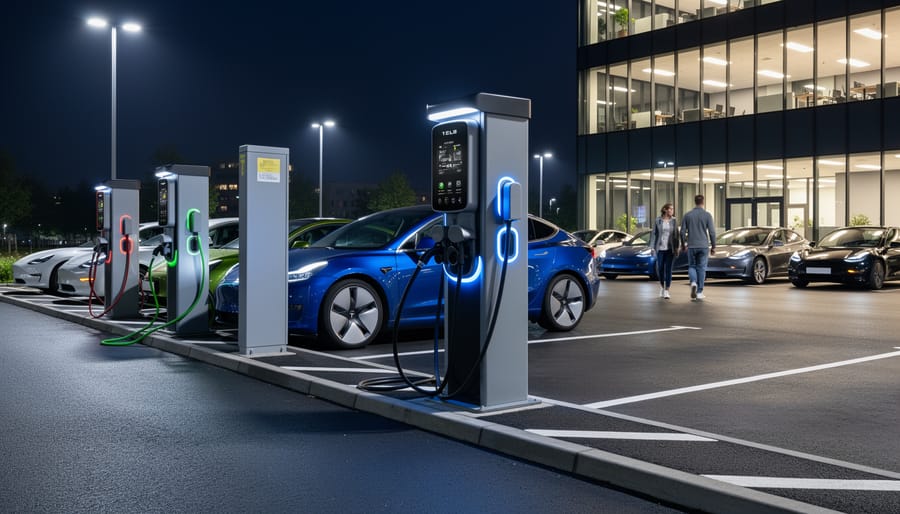
When you drive electric, understanding where 3 phase charging lives in your daily routine makes planning easier. These installations have become the backbone of accessible EV infrastructure, turning formerly challenging charging scenarios into convenient solutions.
Commercial and workplace settings lead the adoption. Office parks often install 11 kW or 22 kW systems in employee parking areas, allowing staff to arrive with 40% charge and leave at 100% after an eight-hour shift. Sarah, a WeGoElectric member in Portland, says her company’s 3 phase setup transformed her commute: “I sold my backup petrol car once workplace charging made range anxiety disappear.”
You’ll commonly find 3 phase charging at:
- Office parks and corporate campuses with dedicated employee parking
- Multi-unit residential buildings and apartment complexes with shared parking
- Shopping centers and retail destinations where extended dwell time supports longer charging sessions
- Public parking facilities near transit hubs and downtown districts
- WeGoElectric network stations designed for community access
Multi-unit housing represents growing adoption. Property managers install 22 kW systems in garage spaces, letting residents charge overnight without competing for limited 240V outlets. The higher power delivery means multiple vehicles can rotate through fewer charging points, solving the shared-resource challenge apartments face.
Public charging networks increasingly deploy 3 phase infrastructure at destinations where people naturally spend 2-4 hours. Restaurants, gyms, and entertainment venues partner with charging providers to add 11 kW posts, turning routine errands into charging opportunities. Learning how to use these public stations takes minutes, and the faster charging speed means you’re not anchored to one spot all day.
WeGoElectric members report that workplace and destination charging with 3 phase systems eliminated their need for frequent fast charging stops, reducing both cost and planning friction in their daily drives.
Does Your EV Support 3 Phase Charging?
Not every electric vehicle can take full advantage of 3 phase charging. Whether yours can depends entirely on the onboard charger fitted at the factory.
Most EVs sold in Europe and other regions with 3 phase infrastructure come standard with onboard chargers rated between 7 kW and 11 kW. Higher-end models, particularly from brands like Tesla, Audi, and Porsche, often offer 11 kW or even 22 kW chargers as standard or optional upgrades. Budget-friendly models and many North American EVs typically max out at 7.4 kW on single phase power, meaning they can’t use 3 phase at all.
You can check your vehicle’s capability in three ways: look up the specs in your owner’s manual under “AC charging” or “onboard charger,” check the manufacturer’s website for your specific trim level, or contact your dealer directly. The number you’re looking for is the maximum AC charging power, usually expressed in kilowatts.
Here’s the good news: if you plug a single phase vehicle into a 3 phase charger, nothing bad happens. The charger simply communicates with your car during the handshake process, detects the limitation, and delivers power at the maximum rate your onboard charger accepts. You’ll charge at your vehicle’s maximum AC rate, just not at the station’s full potential. Think of it like plugging a regular appliance into an industrial outlet, it draws only what it needs, safely.
The reverse isn’t true, though. A 3 phase-capable EV plugged into a single phase outlet will charge more slowly, limited by what that single phase circuit can provide.
Making the Switch: Is 3 Phase Charging Worth It?
Whether 3 phase charging makes sense depends on your specific situation rather than being a universal upgrade.
For drivers covering 50+ miles daily who charge at home overnight, 3 phase installation, typically £800, £1,500 including electrician costs and necessary panel upgrades, can cut charging time from seven hours to under three with an 11 kW charger. Fleet managers and multi-car households often see the quickest return on investment, as the faster turnaround enables more flexible vehicle use.
However, if you’re driving 20-30 miles daily and already charge overnight, single phase charging (around 25 miles of range per hour) probably meets your needs without the upfront expense. The environmental benefit isn’t dramatically different, both methods use grid electricity at similar efficiency rates, but fast charging 2 options at public stations can complement any home setup when you need a quick top-up during longer trips.
Installation requirements matter too. Older homes may need significant electrical work to support 3 phase supply, while newer properties or commercial buildings often have it already. Renters and apartment dwellers face additional hurdles, landlord approval and shared infrastructure costs, which can make 3 phase impractical regardless of driving patterns.
Consider your actual charging habits first. Track when and where you typically charge for a month, then evaluate whether faster home charging genuinely solves a problem you’re experiencing.
Common Questions About 3 Phase Charging
Is 3 phase charging the same as DC fast charging?
No, they’re different technologies. 3 phase charging delivers AC power to your car’s onboard charger, which converts it to DC for the battery. DC fast charging bypasses the onboard charger entirely and feeds DC power directly to the battery at much higher speeds.
Can I install 3 phase charging at home?
It depends on your home’s electrical setup. Many newer homes and commercial properties have 3 phase power available, but most older residential properties only have single phase. You’ll need an electrician to assess your panel and confirm whether your property can support it or if an upgrade is required.
Will plugging into a 3 phase charger damage my single phase vehicle?
Not at all. Your car’s onboard charger only draws what it’s designed to handle. If your EV supports single phase charging at 7 kW, it will simply use one of the three phases and charge at that rate, safely ignoring the extra capacity.
What if I live in an apartment, can I still access 3 phase charging?
Many apartment buildings, especially newer ones, have 3 phase power to the building. Talk to your building management about installing shared charging infrastructure or designated parking spaces with charging access. Some WeGoElectric members have successfully organized resident committees to make this happen.
How much will 3 phase charging increase my electricity bill?
The charging speed doesn’t change how much electricity you use, it just delivers it faster. You’ll pay for the kilowatt-hours your car consumes regardless of whether you charge on single or 3 phase. The main cost difference comes from installation expenses if you need to upgrade your electrical service.
Do I need special cables or equipment for 3 phase charging?
Most public 3 phase chargers have attached cables. For home installations, you’ll need a 3 phase-compatible wallbox unit, but your existing charging cable typically works fine since the connector standard (Type 2 in most regions) supports both single and 3 phase.
These questions reflect what we hear most often from drivers exploring faster charging options. The key takeaway is that 3 phase charging is safe, backward-compatible, and more accessible than many people assume. Whether it makes financial sense depends on your specific situation, daily mileage, available electrical infrastructure, and how much you value reduced charging time.
Understanding 3 phase charging helps you make smarter decisions about your EV infrastructure, whether you’re installing a home charger or planning your daily routine around public charging networks. This technology plays a vital role in making electric mobility practical and efficient for more drivers, cutting charging times and supporting the transition to cleaner transportation.
At WeGoElectric, we’re committed to helping you navigate these choices with clarity. Our community shares real experiences, from workplace charging setups to home installations, so you can learn what works in actual daily use. Explore our membership options to connect with fellow EV drivers, access educational resources, and stay informed about the latest developments in charging technology. The future of sustainable mobility is already here, and you’re part of making it work.
