
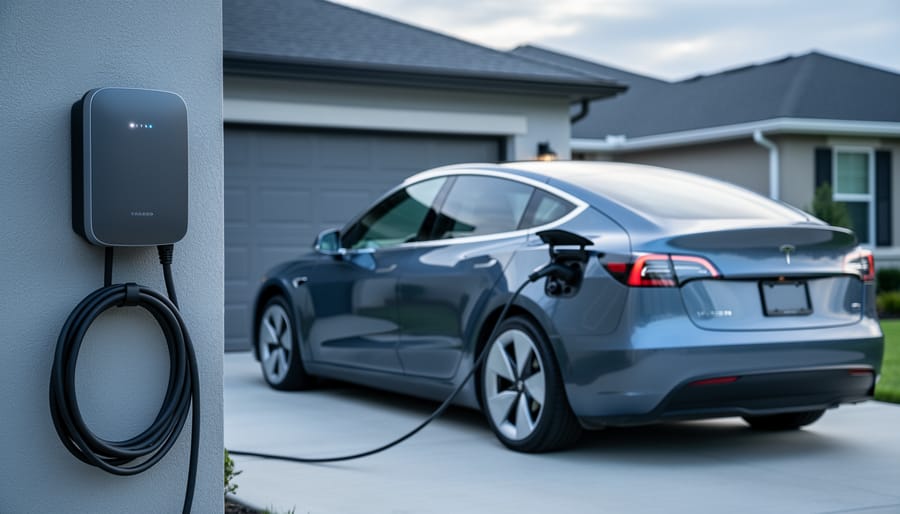
How to Choose the Right EV Charging Station: A Buyer’s Guide for 2026
A user-friendly EV charging station is one that works seamlessly with your routine, requires minimal setup knowledge, and doesn’t force you to decipher technical specifications every time you plug in. The best options for 2026 prioritize intuitive interfaces, reliable performance, and straightforward installation, whether you’re charging at home or managing a small business fleet.
The challenge isn’t finding a charging station. It’s finding one that won’t frustrate you with confusing app controls, compatibility headaches, or installation requirements that demand an engineering degree. Sarah, a Tesla Model 3 owner in Portland, told our community she nearly returned her first charger after spending an hour trying to connect it to her home Wi-Fi. She’s not alone. Many EV drivers waste time and money on stations marketed as “easy” that turn out to be anything but.
What actually defines user-friendly? Three core elements: plug-and-play installation that a confident DIYer can handle in under two hours, an app or interface you can navigate without consulting the manual, and compatibility that works across multiple EV brands without adapters or workarounds. Physical design matters too. The best stations feature cable management that doesn’t leave you wrestling with a tangled mess, weatherproof construction for outdoor installations, and LED indicators clear enough to read in direct sunlight.
This guide cuts through marketing claims to show you exactly what to evaluate, which station types fit different living situations, and where first-time buyers typically go wrong. You’ll learn to match features to your actual needs rather than overpaying for capabilities you’ll never use.
What Makes a Charging Station Truly User-Friendly
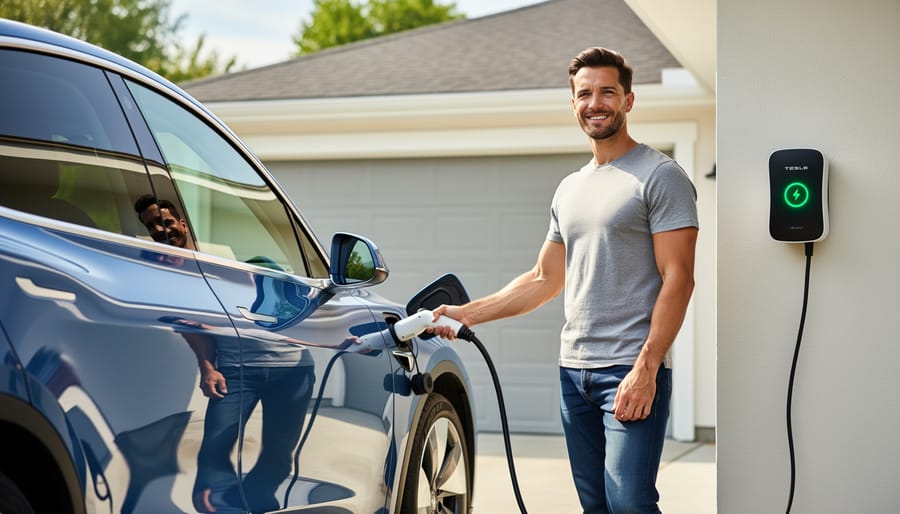
A truly user-friendly charging station should feel invisible when it works perfectly. The best stations require minimal thought to operate, whether you’re plugging in at home after a long day or stopping at a public charger mid-road trip. When Sarah Chen from our community upgraded from her basic Level 1 charger to a smart Level 2 unit last spring, she described the difference as “night and day, I went from fumbling with settings in my garage to just plugging in and forgetting about it.”
The physical interface matters more than most buyers realize. Look for large, clearly-labeled buttons, LED status indicators you can read in bright sunlight or darkness, and cable management that prevents tangled messes. Community member Marcus Williams shared his frustration with a wall-mounted charger that required him to crouch and squint at tiny status lights every time he wanted to check charging progress. “I ended up relying entirely on the app because the station itself told me nothing useful at a glance,” he noted.
Installation simplicity separates weekend projects from months-long headaches. The friendliest home charging stations either plug directly into existing 240V outlets (like dryer plugs) or come with clear hardwiring instructions that any licensed electrician can complete in under two hours. Understanding how to use your chosen station shouldn’t require an engineering degree.
For public and 4-in-1 charging solutions that serve multiple vehicle types, app integration should enhance the experience without becoming mandatory. The best systems let you start charging with a simple tap or card swipe while offering optional app features like scheduling and energy monitoring for those who want deeper control. Payment should never involve downloading three apps, creating accounts, or wondering whether your credit card will actually work at this particular station.
Essential Factors to Consider Before You Buy
Charging Speed and Power Output
Think of charging speed like filling a water tank, some hoses trickle, others gush. With EV charging, power output measured in kilowatts (kW) determines how quickly you’ll top up your battery.
Level 1 charging uses a standard 120-volt household outlet, delivering around 1.4 kW. This adds roughly 3-5 miles of range per hour, fine if you drive 30 miles daily and plug in overnight, but frustratingly slow for longer commutes or weekend road trips. Many EV owners quickly outgrow the portable Level 1 charger that comes with their vehicle.
Level 2 charging steps up to 240 volts (like your dryer outlet) and typically delivers 7-11 kW for home units, though some reach 19 kW. This translates to 25-40 miles of range per hour. For most drivers covering 40 miles daily, an overnight Level 2 charge fully replenishes the battery by morning. A community member in Portland shared that her 7 kW home charger transformed her routine: “I plug in at 9 PM, wake up to a full battery at 7 AM, and never think about charging during the day.”
DC fast charging at public stations pushes 50-350 kW, adding 100-200 miles in 20-30 minutes. However, these aren’t practical for home installation due to cost and electrical demands.
Match your charging speed to reality, not theoretical maximums. Calculate your daily miles, consider your overnight window, and remember that battery size matters, a 75 kWh battery takes longer to fill than a 40 kWh pack, regardless of charger power.
Installation Requirements and Costs
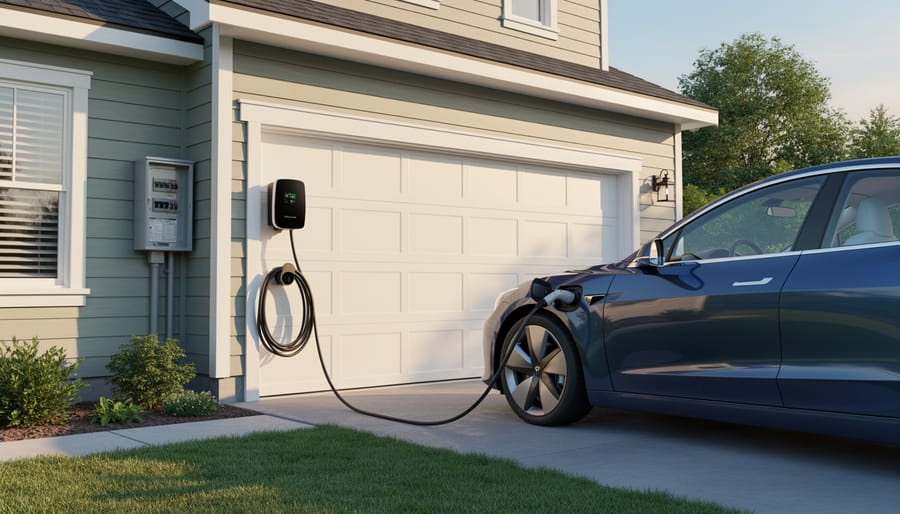
Before you click “buy” on any charging station, take a hard look at your home’s electrical setup, this is where most first-time buyers encounter unexpected costs. Your electrical panel’s amperage capacity determines whether you can simply plug in a Level 2 charger or need a significant upgrade.
Most modern homes have 200-amp service, which typically handles a 40-amp or 50-amp charging circuit without issue. Older homes with 100-amp panels often require a panel upgrade, adding $1,500 to $3,000 to your total project cost. An electrician can assess your current capacity during a consultation that usually runs $100 to $200, money well spent before you commit to a specific charging station.
The installation approach you choose significantly impacts both cost and flexibility. Hardwired stations connect directly to your electrical system and generally require professional installation ($300 to $800 for straightforward setups), but they’re permanent and allow higher amperage. Plug-in models using NEMA 14-50 outlets offer portability and simpler installation, though you’ll still need an electrician to install the outlet itself unless one already exists.
Permitting requirements vary wildly by location. Some municipalities require permits for any electrical work over a certain amperage, adding $50 to $500 and one to four weeks to your timeline. Others have streamlined EV charging permits. Check with your local building department early, community member Sarah learned this the hard way when her installer had to stop mid-project because her city required an inspection she hadn’t scheduled.
DIY installation is feasible only if you’re adding a basic 120-volt outlet and you’re comfortable with electrical work. Anything involving 240-volt circuits, panel modifications, or permanent hardwiring demands a licensed electrician for both safety and code compliance. Most insurance policies won’t cover electrical fires from improper DIY installation.
Budget $800 to $2,000 total for a typical Level 2 home charging setup including equipment and professional installation, but reserve an additional $1,500 buffer if you suspect your electrical system might need upgrades.
Smart Features and Connectivity
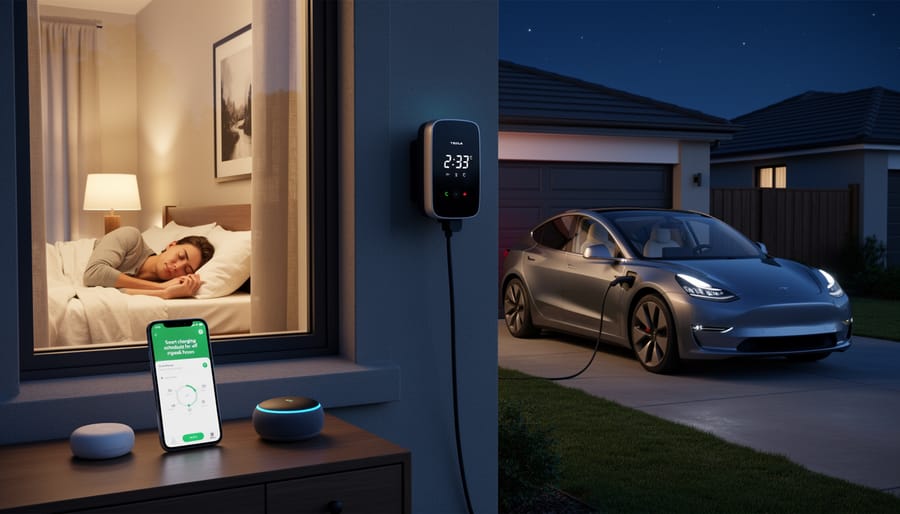
WiFi and Bluetooth connectivity transform a basic charger into a tool that works around your schedule and budget. If you charge overnight when electricity rates drop, app-based scheduling can save you hundreds annually without any effort beyond setting it once. Most modern Level 2 stations let you start, stop, or schedule charging sessions from your phone, helpful when you realize at midnight that you need a full charge by 6 a.m.
Energy monitoring shows exactly how many kilowatt-hours each charging session uses and what it costs. Sarah, a WeGoElectric member in Colorado, discovered her old charger was drawing phantom power even when disconnected; her new smart unit’s monitoring caught the issue immediately. For households with solar panels, advanced stations can prioritize charging during peak solar production hours, maximizing self-generated clean energy use.
Load balancing prevents circuit overloads by automatically adjusting charging speed based on other household electrical demands, a practical safety feature disguised as a smart one.
That said, a charging station with a simple on/off switch still charges your car perfectly well. WiFi dropouts won’t strand you with an uncharged battery; most units default to standard charging if connectivity fails. Evaluate smart features based on your actual habits: if you never adjust your thermostat remotely, you probably won’t micromanage charging sessions either.
Cable Length and Portability
The ideal cable length for your charging station depends entirely on your parking situation, and a bit of future-proofing doesn’t hurt. Most Level 2 chargers come with cables ranging from 12 to 25 feet. If you’re installing a wall-mounted unit in a garage where you park nose-in, a 16-foot cable typically provides plenty of reach, even if you occasionally park at an angle or switch vehicles. For driveways or outdoor installations, consider the 20 to 25-foot range to accommodate different parking positions and potential vehicle changes.
Wall-mounted chargers work beautifully when you have a dedicated parking spot and want a permanent, tidy setup. They’re weather-resistant, secure, and keep cables organized. Portable chargers, meanwhile, offer flexibility for renters, people who split time between properties, or those who want backup charging when traveling. One community member who house-sits frequently swears by her portable unit, she can charge at any standard outlet location without worrying about installation at temporary homes.
The trade-off? Portable units sometimes sacrifice charging speed and smart features, but they eliminate installation costs entirely.
Types of EV Charging Stations Compared
Home Charging Solutions
Level 1 portable chargers represent the simplest entry point for home charging. These units plug into standard 120-volt household outlets and typically add 3-5 miles of range per hour. Perfect for hybrid owners or people with short commutes, they require zero installation beyond finding a grounded outlet near your parking spot. The trade-off? Painfully slow charging that won’t work for anyone driving more than 30-40 miles daily.
Level 2 wall-mounted units are where most single-family homeowners land. Running on 240 volts (the same as your dryer), they deliver 20-40 miles of range per hour depending on amperage. A 32-amp unit strikes the sweet spot for most EVs, fully charging overnight without maxing out your electrical panel. Installation requires an electrician to run dedicated wiring, but once it’s mounted in your garage, you’ve got a permanent solution that adds tangible value to your home.
Smart home-integrated systems take Level 2 charging further with scheduling, energy monitoring, and integration with solar panels or time-of-use electricity rates. Models from companies like ChargePoint and Wallbox let you start charging when rates drop after midnight, track your carbon offset, and even share access with guests through smartphone apps. These features matter most to tech-comfortable homeowners optimizing energy costs.
For condo and apartment dwellers, portable Level 2 chargers offer flexibility. They require a 240-volt outlet but unplug for storage, making them ideal when you can’t permanently install equipment or might move soon.
Public and Commercial Options
Public charging networks have evolved dramatically, offering everything from neighborhood Level 2 stations to 350-kW ultra-fast chargers that can add 200 miles of range in 15 minutes. Most networks operate through app-based systems where you create an account, add payment information, and simply tap to start charging. Some stations accept credit cards directly at the charger, eliminating the need for multiple apps, a feature particularly appreciated by occasional users and road-trippers.
Membership models vary widely. Networks like ChargePoint and EVgo offer pay-per-session options alongside monthly subscription plans that reduce per-kWh costs for frequent users. Workplace and retail charging often provides free sessions during business hours, funded by employers or stores as an amenity. Community charging cooperatives are emerging in multi-unit dwellings, where residents share installation costs and electricity expenses through property management systems.
When evaluating public charging for your regular routine, consider network density in your area, pricing transparency, and whether the stations offer reservation capabilities during peak times. Real-time availability through apps prevents the frustration of arriving at occupied chargers, while interoperability between networks, increasingly common in 2026, means one account can access multiple charging ecosystems without juggling five different apps.
Portable and Travel Chargers
Portable and travel chargers solve a specific challenge: maintaining charging capability when you’re far from your home setup or established networks. These compact units plug into standard outlets, RV hookups, dryer outlets at vacation rentals, or even household receptacles in a pinch, giving you flexibility traditional wall-mounted stations can’t match.
The most practical travel chargers offer adjustable amperage settings, letting you dial down power draw to match whatever outlet you find. A 40-amp capable unit becomes a 16-amp charger when plugged into a basic 120V outlet, preventing circuit breaker trips at unfamiliar locations. This adaptability proves invaluable when visiting family in rural areas or staying at accommodations without dedicated EV charging.
Real emergency use differs from daily charging. Sarah, a WeGoElectric member who regularly drives between charging deserts in the Southwest, keeps a portable Level 2 charger in her trunk alongside adapters for NEMA 14-50 and 6-50 outlets. “It’s insurance,” she explains. “I’ve used it exactly three times in two years, but those three times saved entire trips.”
Weight and storage matter for frequent travelers. Models under 20 pounds with carrying cases integrate seamlessly into road trip planning without sacrificing trunk space for luggage.
Our Recommendations for Different Needs
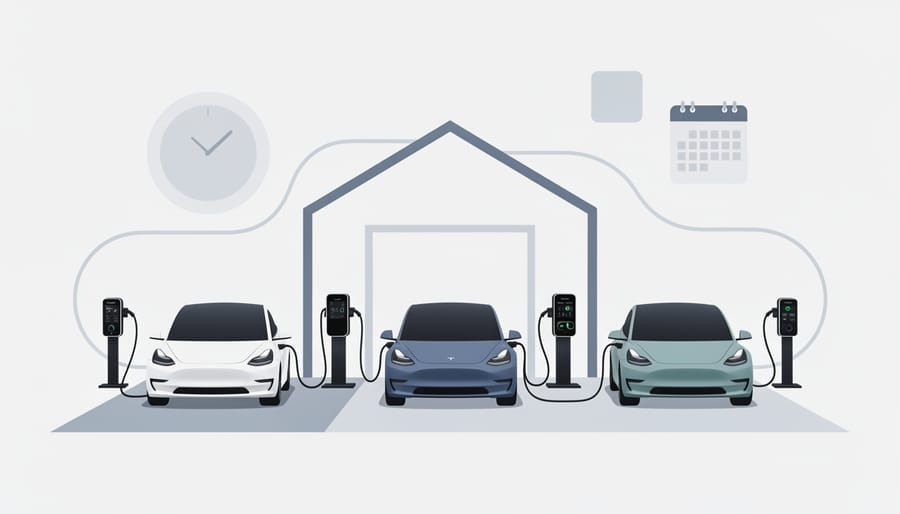
When Sarah moved into her downtown condo last year, she faced a common challenge: limited electrical access in her underground parking spot. After consulting with her building’s management, she opted for a Level 2 portable unit with a NEMA 14-50 plug. This choice gave her the flexibility to take the charger with her when she eventually moves, while still providing overnight charging speeds that handle her 40-mile daily commute easily. Her story illustrates why matching a charging station to your specific living situation matters more than chasing maximum power specs.
For different lifestyles and home setups, certain charging station characteristics align better with real-world needs:
- Urban apartment dwellers: Portable Level 2 units with standard outlet compatibility and compact cable management for shared spaces
- Suburban homeowners with solar: Smart chargers with energy monitoring, scheduling capabilities, and solar integration to maximize self-consumption
- Long-distance commuters: Higher-amperage Level 2 systems (40-48 amps) with longer cables to ensure full overnight recharge even after extended drives
- Multi-vehicle households: Dual-port stations or load-balancing systems that intelligently distribute power between two EVs charging simultaneously
- Budget-conscious first-time EV buyers: Hardwired basic Level 2 units without premium smart features, prioritizing reliability and proven performance over connectivity
James, a suburban homeowner who installed solar panels in 2025, chose a WiFi-enabled charging station that integrates with his home energy system. He scheduled charging during peak solar production hours, essentially powering his morning commute with sunshine from his own roof. The upfront cost ran about $200 more than a basic unit, but the energy savings and satisfaction of maximizing his solar investment made it worthwhile within the first year.
Meanwhile, the Rodriguez family runs two EVs and initially tried charging them sequentially overnight. After calculating that they’d need separate circuits anyway, they invested in a load-sharing system that charges both vehicles simultaneously while staying within their electrical panel’s capacity. This eliminated the midnight alarm to swap cars and the risk of starting the day with an incompletely charged battery.
The right charging station transforms EV ownership from a daily planning exercise into an effortless routine, much like plugging in your phone before bed.
Common Mistakes to Avoid When Choosing a Charging Station
The most expensive mistake new EV owners make is choosing a charging station based solely on price. Sarah from our community learned this the hard way when she bought the cheapest Level 2 charger she could find, only to discover it delivered inconsistent charging speeds and required professional troubleshooting within the first month. What seemed like a $200 saving cost her over $500 in electrician visits and eventually led to replacing the unit entirely.
Another common pitfall involves underestimating your future needs. Many buyers size their charging station for their current vehicle without considering that their next EV might have a larger battery or faster charging capability. Installing a 32-amp charger today might feel adequate, but upgrading to a 48-amp or higher model later means paying installation costs twice. Plan for tomorrow’s vehicle when you’re making today’s purchase decision.
Overlooking installation complexity creates frustration and unexpected costs. Jake thought his garage was “ready to go” for a Level 2 charger, but his electrical panel lacked the capacity for a 40-amp circuit. The solution required a panel upgrade that cost nearly as much as the charging station itself. Before buying any equipment, have a licensed electrician assess your electrical system and provide a realistic installation estimate.
Many buyers also ignore cable management and placement considerations until after installation. Positioning your charger too far from where you typically park, or choosing a cable that’s just barely long enough, creates daily annoyance. If you ever rearrange your garage or switch vehicles, a cable that seemed adequate becomes problematic. Always add at least two feet to whatever cable length you think you need.
Finally, skipping the research on smart features often leads to regret. Some charging stations require monthly subscription fees for app access or energy monitoring. Others lack scheduling capabilities that could save you hundreds on electricity bills through off-peak charging. Understanding these features before purchase, not after, ensures your charging experience matches your expectations. If you’re new to the charging process itself, reviewing a charging step-by-step guide helps you understand what daily use actually looks like with different station types.
Frequently Asked Questions About EV Charging Stations
Installing a home charging station raises plenty of practical questions, especially for first-time EV owners navigating unfamiliar territory. The answers often depend on your specific situation, but understanding the basics helps you plan confidently and avoid charging issues down the road.
Can I install a charging station in a rental property?
You’ll need written permission from your landlord, and installation options will likely be limited to portable Level 1 chargers or plug-in Level 2 units that you can take with you when you move. Some progressive landlords are open to permanent installations if you cover costs, but always get agreements in writing.
How much will my electricity bill increase?
Most EV owners see monthly increases between thirty and sixty dollars, though the exact amount depends on your electricity rate, how much you drive, and when you charge. Charging overnight during off-peak hours can cut costs significantly, and some utilities offer special EV rates that make home charging cheaper than gasoline.
Are all charging stations compatible with all EVs?
Nearly all EVs in North America use the same J1772 connector for Level 2 charging, so compatibility isn’t usually an issue for home stations. Tesla vehicles need an adapter for non-Tesla stations, but one comes with the car.
Do I need a permit to install a home charger?
Most jurisdictions require an electrical permit for hardwired Level 2 installations, and your electrician typically handles this as part of the job. Plug-in units usually don’t need permits, but local codes vary, check with your municipality or installer before starting work.
The compatibility question matters less for home charging than many people expect. The industry has largely standardized on the J1772 plug for residential Level 2 charging, which means your wall-mounted station will work with your next EV even if you switch brands. Tesla owners simply keep an adapter in the car for using non-Tesla stations, a minor inconvenience that takes seconds.
Switching EV brands later doesn’t make your charging station obsolete. One community member installed a Chargepoint Home Flex in 2023 for her Chevy Bolt, then traded up to a Hyundai Ioniq 5 in 2025 without changing anything about her home charging setup. The station worked perfectly with both vehicles, and she appreciated not needing to factor replacement costs into her upgrade decision.
The electricity bill question worries new owners more than it should. Yes, your bill increases, but you’re eliminating gas station visits entirely. When you compare the cost per mile, charging at home usually runs about one-third the price of gasoline, even with the higher electricity usage. One member calculated he spent forty-eight dollars more on electricity each month but saved over two hundred dollars by not buying gas, a net savings that paid for his charging station installation within the first year.
Choosing the right EV charging station isn’t just about plugging in your car, it’s about creating a charging setup that fits seamlessly into your daily life while supporting a cleaner, more sustainable future. When you invest time in understanding your needs, comparing options, and avoiding common pitfalls, you’re not just buying hardware. You’re gaining the freedom to drive electric with confidence, knowing that charging will be convenient rather than complicated.
Every informed choice you make strengthens the broader electric mobility movement. As more people embrace user-friendly charging solutions, we collectively build demand for better infrastructure, smarter technology, and more accessible options for everyone. Your experience matters, whether you’ve discovered a game-changing feature, overcome installation challenges, or found creative ways to optimize your charging routine.
We’d love to hear your story. Join the WeGoElectric community to share what worked for you, ask questions, and learn from fellow EV enthusiasts who’ve walked this path. Together, we’re proving that sustainable transportation doesn’t require sacrifice, it just requires the right tools and a supportive network.
The charging infrastructure of 2026 keeps getting better because people like you demand excellence. As user-friendly stations become the standard rather than the exception, we move closer to a world where going electric is the obvious choice for everyone.
