
Fast Charging kW Explained: Why Your Charging Speed Matters More Than You Think
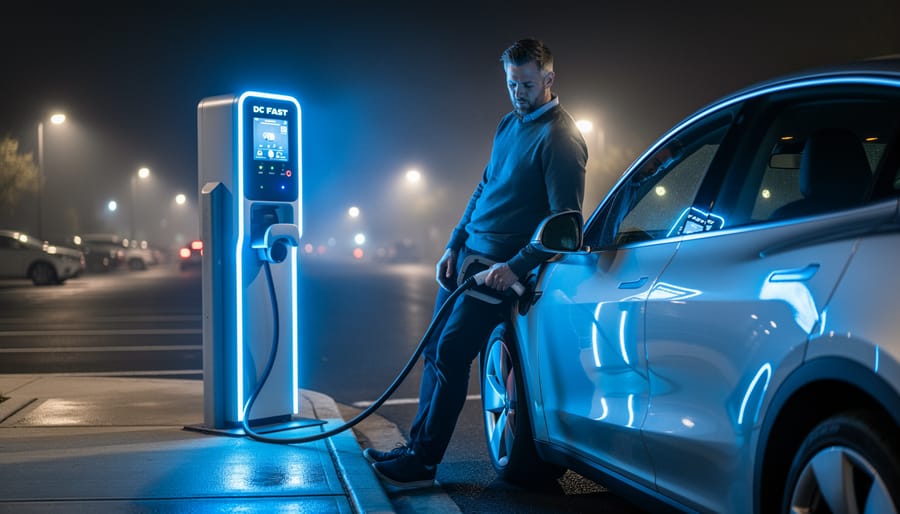
Fast charging for electric vehicles is measured in kilowatts (kW), and understanding this number is the key to predicting how quickly you’ll get back on the road. A 7 kW home charger adds roughly 25-30 miles of range per hour, while a 50 kW public fast charger can deliver 150-180 miles in the same time. At the top end, 150-350 kW ultra-fast chargers can push 200+ miles into your battery in just 15 minutes. The kW rating tells you the maximum power flow between the charger and your vehicle, but the actual charging speed depends on your car’s acceptance rate, battery temperature, and current charge level.
Most EV drivers discover this the hard way during their first road trip. Sarah from Portland thought her car’s advertised 150 kW fast charging meant every session would be lightning quick. Instead, she watched her charging speed drop from 120 kW to 40 kW as her battery climbed past 80%. That’s normal. Charging slows dramatically in the final 20% to protect battery health, which is why experienced drivers plan their stops differently than they did with gas cars.
The kW question matters because it shapes your daily routine and travel freedom. Choose too low and you’re stuck waiting. Assume too high and you’ll overpay for capability your car can’t use. Here’s what you actually need to know to match charging infrastructure to your real life.
What Does kW Actually Mean for Your Charging Experience?
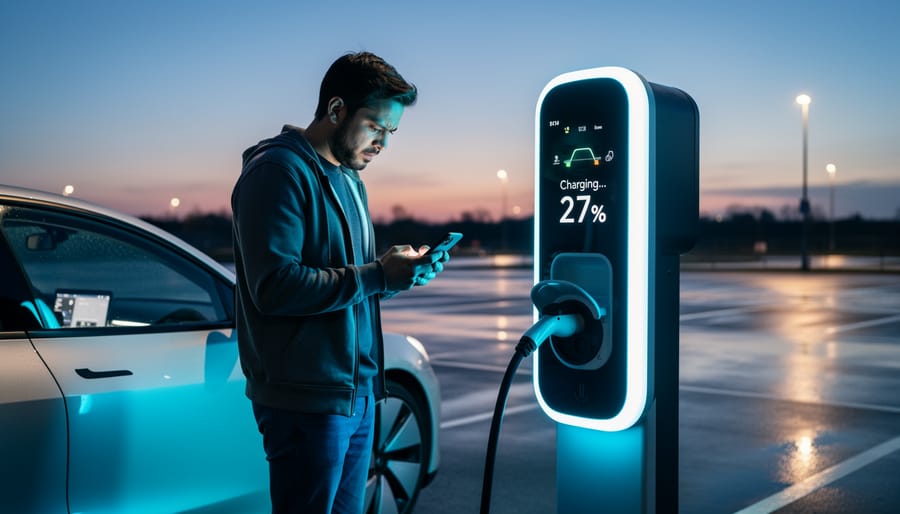
Think of kilowatts like the flow rate from a garden hose. A thicker hose delivers more water per minute, just as higher kW delivers more electricity per hour. When you plug into a 150 kW charger versus a 7 kW home outlet, you’re getting roughly 20 times the power flowing into your battery.
The math is straightforward once you grasp one key distinction. Your battery capacity is measured in kilowatt-hours (kWh), which tells you how much energy it can store. The charging power is measured in kilowatts (kW), which tells you how fast energy flows in. A 75 kWh battery charged at 150 kW will theoretically fill in 30 minutes. That same battery on a 7 kW home charger needs about 10.5 hours.
Real charging never hits these perfect numbers because your car’s systems regulate the power flow for battery health. Temperature, state of charge, and your vehicle’s maximum acceptance rate all affect actual speed. But the core principle holds: double the kW, roughly halve the time.
Here’s where it clicks for most drivers. Your 60 kWh battery at 20 percent charge needs about 48 kWh to reach full. Pull up to a 50 kW charger and you’re looking at roughly an hour. Find a 150 kW station and that drops to around 20 minutes for the same energy transfer, assuming your car accepts that rate.
The bathtub analogy works perfectly. You’re not changing the tub size (your battery capacity), just adjusting how wide you’ve opened the tap. A trickle from a standard outlet eventually fills the tub, but a fire hose gets you swimming much faster. The kW rating tells you exactly how powerful that stream will be, which determines whether you’re grabbing coffee during your charge or settling in for a meal.
The Charging Speed Spectrum: From Slow to Lightning Fast
Level 1 and 2: The Home Charging Foundation
Sarah Chen’s white Model 3 sits in her San Diego driveway every evening, plugged into a Level 2 charger that delivers a modest 7.2 kW. By morning, her battery’s topped off, no gas station stops needed for her 45-mile daily commute. “I thought I’d miss the convenience of quick fill-ups,” she admits, “but waking up to a full ‘tank’ every day actually feels easier.”
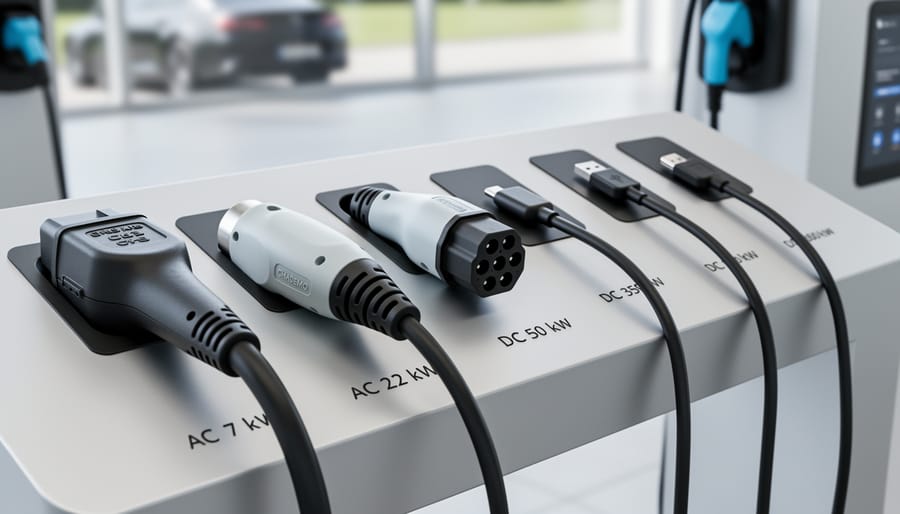
Level 1 charging, using a standard 120V outlet, delivers just 1.4 kW, adding roughly 3-5 miles of range per hour. It’s painfully slow for daily drivers but works perfectly if you drive under 40 miles daily and can plug in for 8-12 hours overnight.
Level 2 chargers (240V) are the sweet spot for home use, offering 3.3-19.2 kW depending on your vehicle’s onboard charger and circuit capacity. Most residential installations provide 7.2-11.5 kW, restoring 25-40 miles of range per hour. That means a typical commuter’s daily 50 miles recharges in under two hours, leaving plenty of buffer before morning.
The real advantage? Cost and battery health. Slower charging generates less heat, extending battery life while taking advantage of cheaper overnight electricity rates.
DC Fast Charging: The 50-150 kW Sweet Spot
This is the charging tier most EV drivers rely on during road trips and quick top-ups. The 50-150 kW range strikes a practical balance between speed and infrastructure reality, fast enough to make charging stops feel like coffee breaks rather than chores, yet widespread enough that you’ll actually find them when you need them.
Here’s what that looks like in practice: a Tesla Model 3 with a 75 kWh battery can add roughly 200 miles of range in about 30 minutes at a 100 kW charger when starting from 20% battery. A Chevy Bolt, which accepts up to 55 kW, adds around 100 miles in the same timeframe. The Hyundai Ioniq 5, capable of accepting 150 kW and above charging can go from 10% to 80% in just over 18 minutes under ideal conditions.
This sweet spot works because it matches how most people actually travel. You’re not sitting idle at the charger, you’re grabbing lunch, stretching your legs, or checking messages. The charging happens in parallel with what you’d do anyway. Compare that to ultra-fast 350 kW stations, which sound impressive but often sit empty because fewer vehicles can use them, or slower 50 kW chargers that turn a quick stop into a 45-minute wait.
Ultra-Fast Charging: 150 kW and Beyond
Ultra-fast charging above 150 kW represents the frontier of EV convenience, slashing road trip stops to coffee-break lengths. At 150-350 kW, compatible vehicles can add 100-200 miles in 10-15 minutes, transforming long-distance travel from a planning exercise into something approaching gas-station spontaneity.
Here’s the reality: your vehicle sets the ceiling. Most 2026 EVs accept 150-175 kW maximum, while premium models like the Hyundai Ioniq 5, Kia EV6, and Porsche Taycan can handle 250-350 kW under ideal conditions. That battery architecture matters more than the charger’s capacity, plugging into a 350 kW station won’t help if your car tops out at 150 kW.
Infrastructure is catching up fast. Networks are installing 350 kW stalls along major corridors, though availability varies wildly by region. The practical benefit? Even if your vehicle can’t use full power, these stations reduce wait times through sheer capacity and often skip the power-sharing issues plaguing older 50 kW installations.
Why Your EV Might Not Charge at the Station’s Maximum kW
You pull up to a 150 kW fast charger, plug in your EV, and watch the display settle at 62 kW. What gives? This scenario frustrates new EV drivers daily, but the truth is your car rarely charges at a station’s maximum advertised speed.
Your vehicle’s acceptance rate sets the first limit. Think of it like a speed limit for electrons flowing into your battery. A Nissan Leaf might cap out at 50 kW even when plugged into a 350 kW ultra-fast charger, while a Porsche Taycan can gulp down over 250 kW. Your car’s onboard systems determine this ceiling, and no amount of wishful thinking changes it.
Battery state of charge dramatically affects charging speed too. Most EVs charge fastest between roughly 10% and 50% battery level. As you approach 80%, the charging curve drops steeply to protect battery longevity. Sarah from Austin shared her learning moment: “I expected consistent speed the whole session. Instead, my Model 3 started at 170 kW but dropped to 40 kW after hitting 75%. Now I plan stops differently, charging just enough to reach my destination rather than always topping off.”
Temperature plays a bigger role than most realize. Cold batteries charge slower because lithium-ion chemistry becomes less efficient below optimal temperatures. On a winter road trip, James watched his charging speed limp along at 35 kW on a 150 kW charger until his battery warmed up. Extremely hot days also trigger thermal management that throttles speed to prevent damage.
Power-sharing between stalls catches many drivers off guard. Some charging stations split power across multiple dispensers. When another EV plugs into the adjacent stall, your 120 kW session might suddenly drop to 60 kW. This practice helps stations manage electrical demand, but it means arrival timing affects your experience.
Understanding these realities helps set accurate expectations. Options like fast charging 2 systems address some limitations with improved power delivery and thermal management, but physics still governs the process. The advertised kW represents maximum potential under ideal conditions, not a guaranteed charging speed for every session.
Matching Charging Speed to Your Lifestyle
The right charging speed isn’t about always using the fastest option, it’s about matching the kW level to your actual needs. Your daily routine probably doesn’t require 150 kW ultra-fast charging, even if it sounds impressive.
For overnight charging at home, Level 2’s 7-11 kW is ideal. You’re asleep for six to eight hours anyway, and your car sits idle in the driveway. Why pay premium rates for speed you won’t use? A 60 kWh battery goes from 20% to 80% in about four hours at 11 kW, which easily fits most people’s overnight window. Plus, slower charging generates less heat and marginally extends battery life over years of ownership.
Your commute and errands change the calculation. If you drive 40 miles daily and charge three nights a week at home, even Level 1’s 1.4 kW could work, though it’s cutting it close. Most drivers find Level 2 the sweet spot for routine charging: fast enough to recover a day’s driving in a few hours, slow enough to avoid premium pricing.
Fast charging earns its cost on road trips. When you’re 200 miles from home with 15% battery, that 150 kW station isn’t a luxury, it’s the difference between a 20-minute stop and a two-hour delay. But using it daily for convenience wastes money and puts unnecessary wear on the battery.
Consider the environmental angle, too. Off-peak home charging often uses cleaner grid power than midday fast charging, and it reduces the infrastructure burden. One community member calculated she’d spend $840 more annually using 100 kW fast charging for her commute instead of overnight Level 2, while adding roughly 15% more carbon emissions from peak-demand electricity. The numbers don’t lie: charge slow when you can, fast when you must.
The Community Impact: How Fast Charging Infrastructure Shapes Electric Mobility
The relationship between charging infrastructure and EV adoption isn’t just theoretical, it’s playing out in communities across the country every day. When a neighborhood gets its first cluster of fast charging stations with diverse kW outputs, something shifts. Suddenly, electric vehicles become a practical option for people who dismissed them months earlier.
Consider Maria, who lives in a Chicago apartment building without garage access. For years, she assumed EVs weren’t for her. Then her workplace installed a mix of 7 kW Level 2 chargers for all-day parking and 50 kW fast chargers for quick top-ups during lunch breaks. That combination made ownership possible. She charges for free during her workday, never worrying about finding a spot at home. Her story repeats itself wherever employers and municipalities invest in varied charging infrastructure.
The key word there is “varied.” A community with only 350 kW ultra-fast chargers sounds impressive, but those stations typically cost more per kWh and aren’t practical for the two-hour coffee shop stop. WeGoElectric’s approach recognizes that different charging speeds serve different needs. Their 4-in-1 charging stations, for example, offer multiple power levels at a single location, letting drivers choose the speed and cost that matches their timeline.
Fleet operators have seen this impact most dramatically. A logistics company in Portland installed a mix of 19 kW overnight chargers and 150 kW fast chargers at their depot. Delivery vans charge slowly and cheaply overnight, while any vehicle needing a midday boost gets rapid charging. This dual approach cut their charging costs by 40% compared to using only fast charging, while ensuring vehicles never sit idle waiting for power.
Road trippers tell a similar story. The difference between a highway corridor with 50 kW chargers every 80 miles versus 150 kW chargers every 120 miles fundamentally changes trip planning. The faster chargers reduce stop time, but the more frequent slower chargers offer flexibility and backup options. Communities along major routes that install both create the confidence needed for long-distance electric travel.
This infrastructure diversity doesn’t just enable EV ownership, it accelerates the transition to sustainable transportation. When people see neighbors, coworkers, and strangers successfully charging at various speeds throughout their day, electric mobility stops feeling like a niche choice and starts looking like the obvious future.
What to Look for When Choosing a Fast Charging Service
When you’re shopping for a fast charging service in 2026, the kW ratings are just the starting point. The best network for your needs balances power delivery with practical factors like where chargers are actually located and whether you can depend on them when you arrive.
Start by considering which kW ranges you’ll need most often. If you’re primarily road-tripping, prioritize networks with abundant 150+ kW stations along your routes. For around-town quick charges, a mix of 50-100 kW chargers might serve you better and cost less. Check that the network’s app shows real-time availability and kW output, nothing’s more frustrating than planning a stop around a 150 kW charger only to find it throttled or offline.
Before committing to any membership or subscription, evaluate:
- kW range availability, Does the network offer the charging speeds that match your vehicle’s capabilities and typical needs?
- Network coverage, Are stations conveniently located along your regular routes and in areas you frequently visit?
- Pricing transparency, Can you easily understand per-kWh costs, idle fees, and how pricing varies by kW level?
- App features, Does the platform provide real-time charger status, kW output data, and trip planning tools?
- Payment options, Are there flexible payment methods, and do memberships actually save you money based on your usage?
- Customer support, Can you quickly get help if a charger malfunctions or billing issues arise?
Location density matters as much as charging speed. A network with 350 kW chargers is useless if none are within 30 miles of your home or workplace. Look for services that show you how to use their stations through clear in-app guidance and responsive customer support.
Finally, read recent user reviews to gauge actual reliability. Even the fastest charger is worthless if it’s broken half the time. The best charging service is one that consistently delivers the kW it promises when you need it.
Understanding kW ratings isn’t about memorizing numbers or always seeking the highest power output. It’s about matching charging solutions to your real life. The driver who commutes 30 miles daily doesn’t need 350 kW charging any more than someone filling a coffee cup needs a fire hose. What matters is having the right tool when you need it.
Your charging strategy should reflect how you actually use your vehicle. Overnight home charging handles most needs. Fast charging fills the gaps during road trips or unexpected situations. Chasing maximum kW at every stop costs more money and often provides minimal time savings for routine charging sessions.
The broader goal extends beyond individual convenience. Accessible charging infrastructure at various kW levels makes electric mobility possible for apartment dwellers, rural communities, and first-time EV buyers who might hesitate without diverse options. When you choose the right station based on actual needs rather than maximum specs, you contribute to sustainable transportation while optimizing your own experience.
As charging networks expand in 2026, kW range availability will continue improving across urban and rural areas. Share your charging experiences with other drivers. Your insights about what works in specific situations help newcomers navigate their electric journey with confidence. The electric future runs on informed choices, not just fast electrons.
