
How Much Does Electric Vehicle Charging Station Installation Cost? (2026)
Installing an electric vehicle charging station at home or your business typically costs between $1,400 and $2,200 for a Level 2 charger, the most popular choice for residential use. That figure covers both the charging equipment itself and professional installation. Level 1 chargers run cheaper at $300 to $4,500 total, while commercial DC fast chargers can cost anywhere from $10,000 to over $140,000.
What drives these costs? The biggest factor is which charging level you choose. Level 2 equipment alone ranges from $400 to $6,500, with installation adding another $600 to $12,700 depending on your electrical setup. If your home’s electrical panel needs an upgrade to handle the additional load, you’re looking at the higher end of that range. Distance from your panel to the installation location matters too. A garage with an adjacent breaker box keeps costs down, while running new conduit across your property pushes the price up.
The good news? Federal tax credits, utility rebates, and local incentives can reduce your out-of-pocket costs significantly in 2026. Understanding what influences your final bill helps you budget accurately and avoid surprise expenses when your installer provides a quote.
Charging Station Costs by Charger Level
Level 1 Chargers: The Budget-Friendly Starting Point
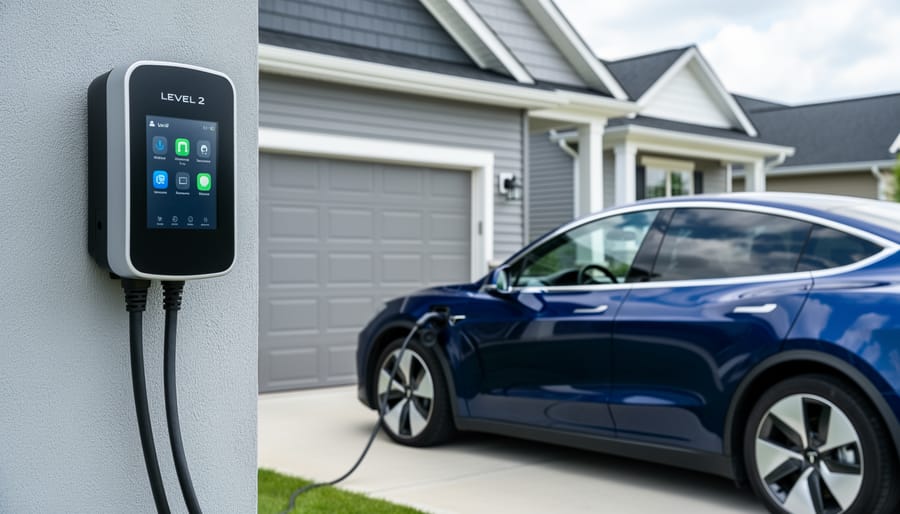
Level 1 chargers are the most economical entry point into home EV charging, with equipment costs ranging from $300 to $1,500 and installation costs from $0 to $3,000. Many EVs include a Level 1 charging cable in the box, which means you might already own everything you need.
The reason installation costs can be zero is simple: Level 1 chargers plug directly into a standard 120-volt household outlet. If you have a grounded three-prong outlet in your garage or carport within reach of your parking spot, you’re ready to charge. No electrician, no permits, no modifications required.
Installation costs enter the picture when you need an outlet installed closer to your parking area or want a dedicated circuit for safer, more reliable charging. Even then, the work is straightforward compared to higher-level installations. Running a new 120-volt circuit typically costs less than adding the 240-volt infrastructure that Level 2 systems demand.
Level 1 is ideal for drivers who cover fewer than 40 miles daily and can charge overnight.
The tradeoff? Charging speed. Level 1 adds roughly 3 to 5 miles of range per hour, meaning a full charge takes 12 to 24 hours for most battery-electric vehicles. For light usage patterns, though, that’s rarely a problem.
Level 2 Chargers: The Sweet Spot for Most Installations
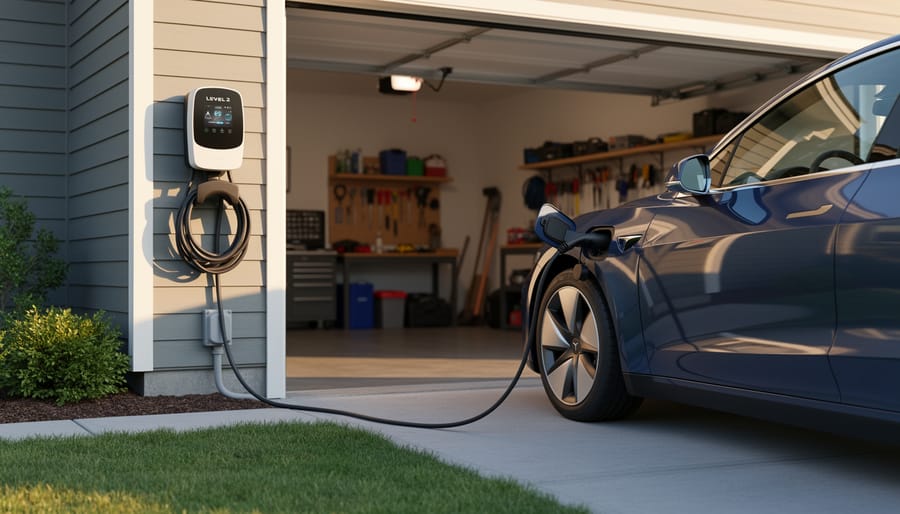
Level 2 chargers strike the ideal balance between charging speed and installation affordability, which explains why they dominate residential, workplace, and small business installations. Equipment costs typically run between $400 and $6,500, depending on features like Wi-Fi connectivity, cable length, and weather resistance. Installation adds another $600 to $12,700, though most homeowners and businesses land in the $1,400 to $2,200 range when combining both expenses.
What makes Level 2 the sweet spot? These chargers deliver 25 to 50 miles of range per hour, enough to fully charge most EVs overnight or during a workday. That practical speed means you’re not tethered to the charger for hours like with Level 1, yet you avoid the infrastructure overhaul that DC fast charging demands.
For homes, Level 2 chargers handle the daily routine: plug in when you get home, wake up to a full battery. Workplaces benefit from employee satisfaction and lower fleet fueling costs. Small businesses gain a competitive edge in attracting talent and customers who drive electric. The upfront investment pays off in convenience that just works.
DC Fast Charging: Commercial-Grade Investment
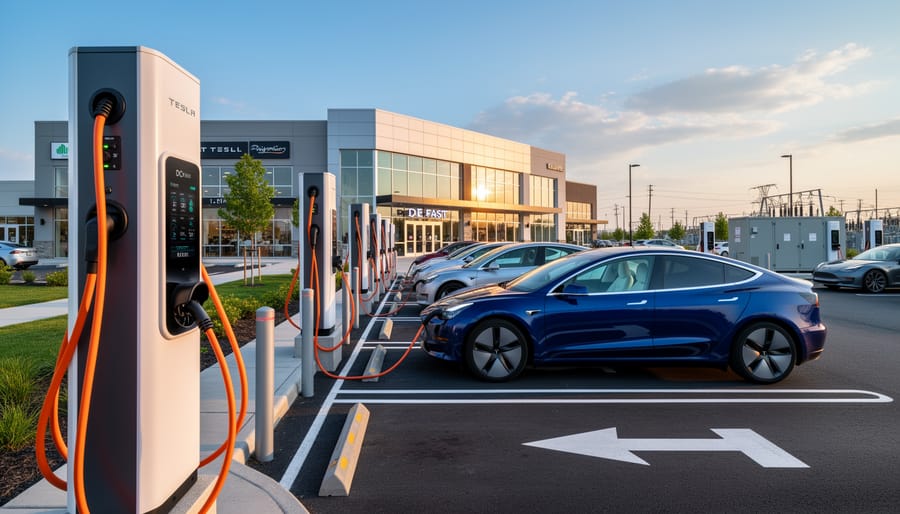
DC fast charging represents a significant leap in both capability and investment, with equipment costs ranging from $10,000 to $140,000. These aren’t chargers you’ll find in residential garages. The eye-watering price reflects the robust electrical infrastructure required: DCFC units deliver fast charging kW levels that can add 100+ miles of range in under 30 minutes, demanding dedicated high-voltage service, substantial electrical panel capacity (often 480V three-phase commercial power), and specialized safety equipment. Installation costs can easily match or exceed equipment prices when you factor in utility coordination, transformer upgrades, trenching for underground lines, and permitting for commercial electrical work.
Who actually needs this firepower? Highway corridor operators installing charging plazas, fleet managers running delivery or transit vehicles with tight turnaround times, and public charging networks competing on speed and convenience. A single DCFC station at a highway rest stop can serve dozens of vehicles daily, generating revenue that justifies the upfront expense.
The community impact extends beyond individual convenience. Fast charging availability transforms range anxiety into a non-issue, making electric vehicle ownership viable for apartment dwellers and long-distance commuters. When a local business or municipality installs DCFC, they’re not just adding infrastructure, they’re signaling that sustainable transportation is practical, accessible, and here to stay. That investment ripples outward, encouraging EV adoption across the entire community.
What’s Included in Installation Costs
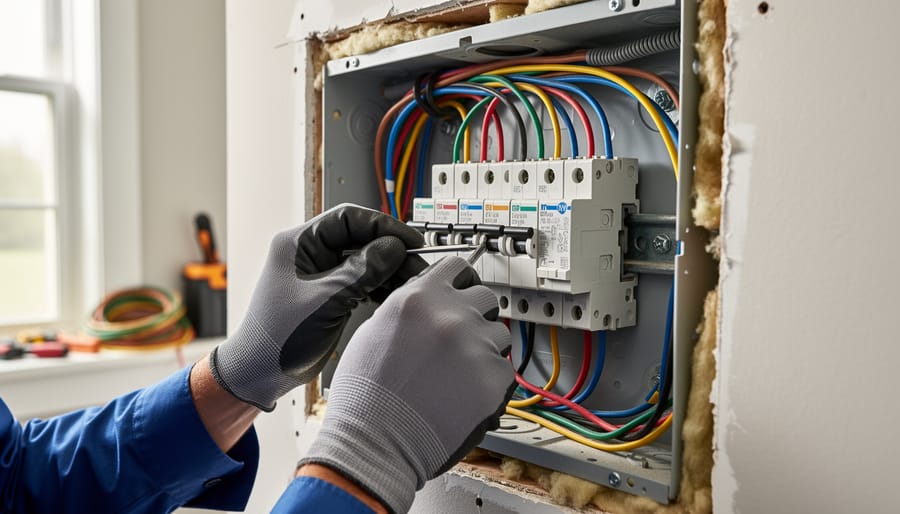
When you see a quote for charging station installation, you’re not just paying for someone to mount a box on your wall. The final bill reflects a series of distinct tasks and materials, each with its own cost. Understanding these line items helps you evaluate quotes and spot where your specific situation might push expenses higher or lower than the typical range.
The biggest variable is often your electrical panel. Many homes built before 2010 have 100-amp or 150-amp panels that can’t safely support a Level 2 charger alongside existing household loads. A panel upgrade to 200 amps typically adds $1,200 to $3,500 to your project, depending on whether your utility service needs upgrading too. If your panel already has adequate capacity and available breaker slots, you skip this cost entirely, one reason identical chargers can have wildly different installation bills.
Next comes the dedicated circuit that feeds your charger. Most Level 2 units require a 240-volt, 40-amp or 50-amp circuit, which means new wiring from your panel to the charging location. The materials for this circuit, copper wire, breakers, junction boxes, run $200 to $600 depending on wire gauge and length. Conduit to protect that wiring adds another layer. Indoor installations might use simple plastic conduit at $3 to $5 per foot, while outdoor runs often require metal conduit at $8 to $12 per foot. A 50-foot run can mean $400 in conduit costs alone.
Here’s where the major cost components typically break down:
- Electrical panel upgrade (if needed): $1,200, $3,500
- Dedicated circuit materials (wire, breaker, boxes): $200, $600
- Conduit and protective materials: $150, $600, depending on run length
- Permit and inspection fees: $50, $500, varying widely by municipality
- Licensed electrician labor: $400, $2,000 for typical 4-8 hour jobs at $75, $150/hour
- Trenching or concrete work (outdoor installations): $300, $2,000 per 50 feet
- Smart features or network connectivity setup: $0, $500
Labor represents the largest single expense in most installations. A straightforward garage installation where the panel is nearby might take four hours. An outdoor carport setup 80 feet from the panel, requiring trenching through landscaping, can stretch to two full days of work. Electricians in urban markets charge $100 to $150 per hour, while rural areas often see $75 to $100. That geographic difference alone can shift your total by $500 or more.
Permit and inspection requirements vary dramatically by jurisdiction. Some cities charge a flat $75 residential permit fee. Others calculate fees based on project value, pushing the cost to $300 or higher. A few rural counties don’t require permits for residential charging installations at all, though skipping permits where required risks insurance problems and code violations.
If your charger goes outdoors or in an unfinished garage, you’ll need mounting hardware and possibly concrete work for a pedestal base. A wall-mounted installation on existing structure costs $100 to $200 for materials. A freestanding pedestal with concrete footing adds $400 to $800. Trenching under driveways or through established landscaping can run $15 to $40 per linear foot.
Finally, smart connectivity features, Wi-Fi modules, cellular connections, or integration with home energy management systems, sometimes come as optional add-ons. Basic chargers plug in and work. Networked models let you schedule charging, track energy use, and potentially participate in utility demand-response programs that reduce your electricity costs. Setup for these features ranges from free (if you handle the app yourself) to $500 for professional network integration.
Two neighbors buying identical chargers can see quotes that differ by $2,000 because one has a modern panel with space ten feet from the garage, while the other needs a panel upgrade and 60 feet of conduit. The charger is the same. Everything around it is not.
Six Factors That Change Your Final Price
Your total installation bill depends on six interrelated variables. Understanding these factors helps you anticipate costs and identify where you might have room to negotiate or make strategic choices that bring the price down.
- Distance from Electrical Panel to Charger LocationEvery foot of wiring adds material and labor costs. Installing a charger in a garage directly adjacent to your electrical panel might cost $600, $800 in labor and materials, while running 100 feet of conduit to a detached garage or driveway can push installation costs past $3,000. Electricians charge for wire, conduit, trenching, and time. If you’re planning ahead, choose a charger location that minimizes this run. For new construction or major renovations, plan your panel location with future charging needs in mind.
- Current Electrical Capacity and Panel UpgradesMany homes built before 2000 have 100-amp or 150-amp electrical panels that can’t support a Level 2 charger drawing 30-50 amps without upgrades. A panel upgrade to 200 amps typically costs $1,500, $3,000, sometimes more if your utility requires a service line upgrade. Newer homes usually have sufficient capacity, but you’ll need a licensed electrician to assess your specific setup. Commercial installations often require 3 phase charging capability, which involves different equipment and higher costs if the building doesn’t already have three-phase service.
- Charger Features and Smart CapabilitiesA basic Level 2 charger costs $400, $700, while units with WiFi connectivity, scheduling, energy monitoring, and load management features run $800, $2,000 or more. Smart chargers let you track usage, schedule charging during off-peak hours to reduce electricity costs, and integrate with home energy management systems. The equipment premium pays for itself over time through optimized charging, but it increases upfront costs. Commercial properties often choose networked chargers ($1,500, $6,500) that handle payments, access control, and fleet management.
- Local Permit and Inspection RequirementsPermit fees vary dramatically by jurisdiction, from $50 in some rural areas to $500+ in cities with strict electrical codes. Some municipalities require multiple inspections at different stages, each adding scheduling delays and costs. Your electrician typically handles permitting, but those fees get passed through. Research your local requirements early or ask your installer for a breakdown. Cities with established EV infrastructure often have streamlined permit processes that reduce both time and expense.
- Installation ComplexityMounting a charger on an interior garage wall with nearby panel access represents the simplest scenario. Outdoor installations require weatherproof enclosures, conduit, and often concrete pads ($200, $800 additional). Mounting on brick, stone, or finished surfaces costs more than bare drywall. Trenching under driveways or landscaping to reach a front-yard parking spot can add $1,000, $2,500. Assess your specific site conditions honestly when budgeting.
- Geographic Location and Labor RatesLicensed electrician rates range from $50, $80 per hour in lower-cost regions to $100, $150+ per hour in major metropolitan areas like San Francisco, New York, or Seattle. A four-hour installation job costs $400 in labor in one market and $800 in another, with identical scope. Urban areas also tend to have higher permit fees and stricter code requirements. Rural installations might face trip charges if you’re outside the electrician’s normal service area. Get quotes from multiple local contractors to understand your market’s baseline.
These factors interact in ways that make your installation unique. A simple garage setup in a home with adequate electrical capacity might hit the lower end of the typical $1,400, $2,200 range, while a complex outdoor installation requiring a panel upgrade and extensive trenching can easily exceed $5,000. The good news: most of these variables become clear during a site assessment, giving you accurate numbers before you commit.
Professional Installation vs. DIY: What You Need to Know

The DIY question comes up every time someone sees a $2,000 installation quote for a charger that costs $500. The math looks tempting, but the reality depends entirely on which charger level you’re installing and what local codes allow.
For Level 1 chargers that plug into existing 120V outlets, installation is often genuinely DIY-friendly. You’re not running new circuits or upgrading panels, just plugging in and charging. Most jurisdictions don’t require permits for using an existing outlet, making this the one scenario where doing it yourself makes practical and legal sense. If you’ve already got a NEMA 5-15 outlet in your garage, you can install a Level 1 unit without hiring anyone.
Level 2 installations cross into different territory. Running a new 240V circuit requires pulling permits in most areas, and many municipalities mandate licensed electrician work for any new circuit over 50 amps. Even if your local code doesn’t explicitly forbid DIY electrical work, your charger warranty almost certainly does. Most manufacturers void coverage if installation wasn’t performed by a certified electrician, leaving you unprotected if something fails.
Commercial installations and all DC fast charging projects require professional installation without exception. No manufacturer, inspector, or insurance company will accept DIY work on these systems.
Pros of Professional Installation
- Handles all permits and passes required inspections without delays.
- Protects manufacturer warranty and maintains insurance coverage.
- Ensures code compliance and proper grounding for safety.
- Identifies electrical capacity issues before they become hazards.
Cons of Professional Installation
- Labor costs typically add $600, $1,500 to total installation price.
- Scheduling may require waiting several weeks during busy seasons.
- You have less direct control over installation timeline and decisions.
The hidden expenses of DIY mistakes run deeper than just fixing errors. Failed inspections mean reinspection fees. Improper installations can trip breakers repeatedly, damage your vehicle’s charging system, or create fire risks. Insurance claims for electrical fires caused by unpermitted work are routinely denied.
Professional electricians bring expertise that goes beyond running wire. They’ll choose the right charger location to minimize circuit length, identify whether your panel has capacity for the new load, navigate permit processes efficiently, and ensure everything meets National Electrical Code standards. For Level 2 installations, their value isn’t just technical skill, it’s the peace of mind that your $1,400, $2,200 investment is safe, legal, and fully warrantied.
Ways to Reduce Your Installation Investment
Smart planning can significantly cut your charging station installation investment without sacrificing quality or safety. Start by thinking strategically about location. The closer your charger sits to your electrical panel, the less you’ll spend on wiring and conduit. A garage installation typically costs $300 to $800 less than a carport at the far end of your driveway. If you’re flexible about placement, walk your property with your electrician to find the sweet spot that balances convenience with cost.
Federal and state incentives deserve serious attention. The federal tax credit covers 30% of installation costs up to $1,000 for residential installations, while commercial properties can claim up to $100,000. Many states stack additional rebates on top. California’s Clean Vehicle Rebate Project, for instance, has historically offered substantial installation support. Research what’s available in your area before you commit to a contractor, because timing matters for claiming these benefits.
Your utility company may be your secret weapon. Many offer rebates ranging from $250 to $1,000 for installing Level 2 chargers, and some provide free or discounted equipment through managed charging programs. These programs typically involve charging during off-peak hours when electricity is cheaper and the grid less strained. You save on installation and ongoing energy costs while supporting grid stability.
Bundling projects generates real savings. If you’re already planning solar panel installation, adding a charger to that project eliminates duplicate permits, site visits, and mobilization fees. Similarly, installing during new construction or major renovation means electricians are already on site and your walls are already open.
Group purchasing works exceptionally well for workplaces and multi-unit housing. When five neighbors or an entire apartment complex installs together, contractors often discount per-unit installation by 15% to 25%. Some communities have even explored 4-in-1 charging stations that serve multiple vehicles from shared infrastructure, dramatically reducing per-user costs in parking areas.
Common Questions About Charging Station Installation Costs
Does installation cost vary by EV brand?
No, installation costs depend on your home’s electrical setup and the charger level you choose, not your vehicle brand. All EVs use standardized connectors (J1772 for Level 2, CCS or CHAdeMO for DC fast charging), so any compatible charger works with any EV.
Can I claim installation on my taxes?
Federal tax credits for residential EV charger installations have fluctuated over recent years, and state-level incentives vary widely. Check the current IRS guidelines and your state’s energy office for available credits, many homeowners can claim 30% of installation costs up to specific caps.
How long does installation take?
A straightforward Level 2 installation typically takes four to eight hours if your electrical panel has adequate capacity. Installations requiring panel upgrades, trenching, or permit delays can extend to several days or even weeks, depending on your municipality’s inspection schedule.
What ongoing costs should I expect?
Your main ongoing expense is electricity, which varies by local rates and how much you drive, most drivers spend $30 to $60 monthly to charge at home. Some smart chargers have optional subscription features for advanced monitoring, but basic operation costs nothing beyond the power you use.
Do I need to upgrade my home’s electrical service?
Many homes built after 2000 have 200-amp service that can handle a Level 2 charger without upgrades. Older homes with 100-amp panels often need an upgrade if you’re adding a 40-amp or 50-amp charging circuit, especially if you already run high-draw appliances like central air conditioning or electric water heaters.
Will a charging station increase my property value?
Studies suggest EV chargers add appeal to tech-savvy and environmentally conscious buyers, particularly in areas with high EV adoption. While appraisers don’t yet assign a consistent dollar value to installed chargers, the convenience factor can differentiate your home in competitive markets and may command a modest premium.
Once you have your charger installed and understand the costs involved, learning how to use charging stations efficiently becomes the next step in your electric vehicle journey. Many new EV owners find that home charging covers 80% of their needs, with public stations filling in for longer trips. The community around electric mobility continues to grow, and your installation investment connects you to a network of drivers sharing tips on optimizing charging schedules, taking advantage of off-peak electricity rates, and supporting local charging infrastructure. If cost remains a concern after reviewing these common questions, revisit the strategies in the previous section, incentives, rebates, and smart installation planning can reduce your out-of-pocket expenses significantly while still delivering the reliable charging setup your household needs.
Installing an electric vehicle charging station is an investment in sustainable mobility that pays dividends through convenience, cost savings, and environmental impact. While most homeowners can expect to spend between $1,400 and $2,200 for a Level 2 installation, your actual costs will depend on your electrical setup, charger features, and site-specific factors. That’s why getting quotes from three certified electricians is essential, each installation is unique, and local professionals can identify variables that dramatically affect your final price.
At WeGoElectric, we believe accessible charging infrastructure strengthens communities and accelerates the transition to clean transportation. Whether you’re installing a charger in your garage, at your workplace, or as part of a neighborhood initiative, you’re contributing to a network that makes electric vehicles practical for everyone. Take advantage of federal and state incentives, explore utility rebate programs, and choose a solution that fits your charging needs without overspending on unnecessary features.
You’re not just buying equipment, you’re joining a movement toward sustainable transportation that reduces emissions, lowers fuel costs, and builds resilient communities. Get those quotes, ask questions, and make an informed decision that works for your budget and your electric future.
